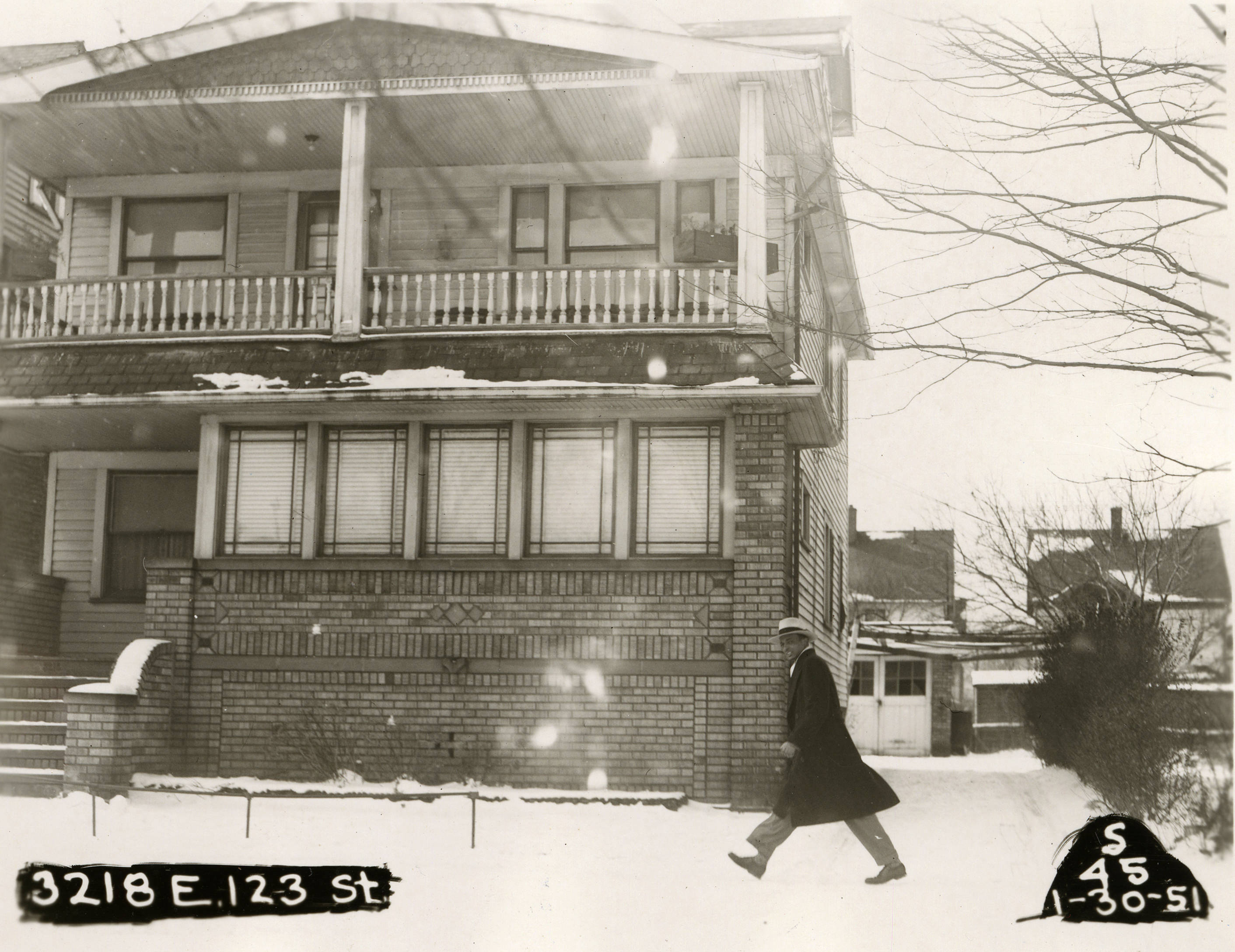
In this 2025 interview, Barbara Anderson discusses her early life growing up in a foster family on E. 151st and Bartlett in the 1950s. She describes how growing up in a foster family and in a neighborhood with many ethnicities prepared her for her organizing work later in life. She details being the first Black family to move into the Slavic Village neighborhood in the 1980s and the racism and hostility that her family experienced. She describes how losing her house due to predatory lending practices inspired her to advocate for fair housing practices, which eventually led her to the East Side Organizing Project (ESOP), where she acted as treasurer and president. Finally, she discusses her work for her own nonprofit, Another Chance of Ohio and leaves a message for future generations.
In this 2025 interview, Shirley Bell, the executive officer and founder of RevLove Farm, discusses her early life in the Mt. Pleasant and Kinsman area. She describes her educational path and the history of urban agriculture in the area, including the history of RevLove farm. She concludes the interview by discussing the ways that Cleveland has shaped her as a person and by describing the importance of community and food sovereignty.
In this 2025 interview, Marion Anita Gardner discusses her early life in Cleveland, memories at Olivet Institutional Baptist Church, and her eventual move to the Mt. Pleasant neighborhood. Gardner describes her work as the founder and CEO the Concerned Citizens Community Council on Kinsman Road, her work as a machinist at TRW, and her early education. At the end of the interview, Gardner expresses her love for Cleveland and leaves a message for future generations.
Cynthia Harris-Allen was born in 1946 and grew up in the Mt. Pleasant neighborhood on Cleveland’s East Side. She discusses her father’s work as a bricklayer and how he was among the first African Americans in the Bricklayers & Masons Local 5 union; racial discrimination faced by Black builders and building tradesmen; her father’s jazz band; the racial makeup and businesses of her neighborhood growing up in the mid-20th century; hanging out at Shaker Square and trick or treating at Halloween in Shaker Heights; and the Civil Rights Movement. Late in the interview, Harris-Allen discusses her writing interest, banking career, and enrollment at Cuyahoga Community College in retirement. This interview was part of a Literary Cleveland community storytelling project.
Gerald Hughes is from Lancaster, Pennsylvania. He grew up in a town that was majority white. He went to a Mennonite school in Indiana and through a volunteer program gained his first experience in the city of Cleveland. He initially hoped to work in the steel mills but they were on strike when he arrived in the city. Hughes was not fond of his first trip to Cleveland as it was a cold, wet day in March. His wife worked at Standard Oil and when he first moved to the area he moved by the place he could continue to carry out his church volunteer program, in the Mt. Pleasant area. He was a music major, became an educator and an administrator in the Cleveland Public School System. He was around the Mt. Pleasant area to witness white flight, then moved to the Cleveland Heights area, only to watch his neighborhood go from integrated to predominantly black again. He remained in the public school system at Sowinski (no longer in existence) and Harvey Rice. He witnessed the Polish community change to black in around Sowinski and later went to the predominantly black school, Harvey Rice. He was an administrator during desegregation of the Public School System. He completed a follow-up interview due to equipment failure: see interview 990040.
In this 2024 interview, Linda James discusses her early life in the Mount Pleasant neighborhood and her memories moving to Cleveland, Ohio from Kentucky in 1956. She describes the differences between Cleveland and Kentucky— particularly that Kentucky was less racially segregated than Cleveland was. James describes key memories: playing in the outdoors, going to hear music, and hearing Muhammed Ali speak. She also discusses her experience in Cleveland Metropolitan School District, her work as a nurse, and the changes she witnessed in Cleveland over time.
In this 2024 interview, Felescia Jordan, an employee at the Thea Bowman Center, discusses her life in the Mount Pleasant neighborhood and the impact of the Thea Bowman Center on her life. Jordan talks about moving to Cleveland from Birmingham, Alabama when she was twelve years old, growing up along Union Avenue, and supporting her children with help from the Thea Bowman Center.
In this brief interview conducted as part of a Literary Cleveland storytelling project, Diane Kelley discusses growing up in Cleveland Heights in the 1970s-80s, moving to Cleveland’s Mt. Pleasant neighborhood in 1988. She discusses her poetry and other writing. She also discusses moving back to the northern part of Cleveland Heights in more recent years.
In this 2024 interview, Thea Bowman Center employee Bernard Long discusses his life growing up on E. 120th Street in the Mount Pleasant neighborhood. He describes attending Catholic school, living in the area during the Civil Rights Movement, and spending time at Boddie Studio on Union Avenue. He describes the diverse ethnicities that lived in the area and the later white flight that occurred when white families moved out of Mount Pleasant into the suburbs. He also discusses his family, his friends, the impact of music, and the role of the church.
Kamilah Moore-El describes growing up in the Woodland Hills neighborhood on Cleveland’s East Side in the 1980s. She discusses Woodland Hills Park, attending John Adams High School, John Marshall High School, and MLK High School, the Sidaway Bridge, and living in the Mt. Pleasant neighborhood since 1990. This interview was recorded as part of a Literary Cleveland storytelling project at the Mt. Pleasant branch library.
Dianne McIntyre was born at Mt. Sinai Hospital in Cleveland and grew up in Glenville early on and then moved to the Mt. Pleasant area with her mother and father on East 141st Street. Their family was the first black family on the block, although her father grew up around the corner. She recalls the onset of white flight and the neighborhood changing from white to black. She talks about how her parents made sure they had substitutes for things they could not do because of their race. She recalls stories about the change in demography of John Adams High School and understanding the de facto segregration in Cleveland. McIntyre talks about her mother, Dorothy, and her growing up in LeRoy, New York. Dianne tells more of her mother’s life when she discusses getting her pilot’s license. She tells about her father’s family coming to Cleveland and her father working at Westinghouse as a driver and then at the U.S. Postal Service. She points out the Murtis Taylor Center as a point of interest in the community.
Donna McIntyre Whyte is a Cleveland native, born in 1948, and grew up in the Glenville neighborhood, and then later on to the Mt. Pleasant area. Her father taught her and her sister many domestic and handy skills such as how to work on cars. She lived close to her grandparents, close enough to walk their alone as a child. Her grandparents have interesting stories, and she appreciated them and spent a lot of time with them. She does not recall any distinct instances of segregation, but does remember when the building of John F. Kennedy High School, and that the boundaries they drew for the school district seemed like a racial boundary in order to make Kennedy an “all black school.” At this time in the early to mid sixties, white families were fleeing the city and created South High School, the “white” equivalent to JFK. Whyte attended John Adams High School because it had honors programs and because her father went there. She was friends with people who went to JFK because the school was built her junior year. The interview stops at her high school graduation. She provides a great account of what it was like to grow up in the Glenville and Mt. Pleasant areas in the 1950s and 1960s.
In this 2025 interview, Myra Simmons discusses growing up off Kinsman Road in the Mt. Pleasant neighborhood in the 1960s. She describes the long-standing businesses of her childhood, her childhood home, and her hobbies within and outside of school. She also talks about working at the steel mill for 42 years, her opinions of labor unions, and her later purchase of multiple homes in the neighborhood. The interview concludes with her hopes for the future and her advice for future generations.
In this 2025 interview, Bernita Polk Thomas talks about her family’s move from Central to Mt. Pleasant and her life growing up in the neighborhood. She mentions racial changes, her experiences in the public schools, and extracurricular activities she participated in. Thomas Polk ends her interview by emphasizing the importance of understanding the past through history.
Jimmie Waugh discusses moving from Mississippi to the Mount Pleasant neighborhood in Cleveland, Ohio around 1959. He talks about attending Alexander Hamilton Middle School and John Adams High School before joining United States Military in 1965. He then tracks his professional pathway after leaving the military: he worked for the Warrensville Fire Department and then began doing maintenance work for the Thea Bowman Center when it still a part of Epiphany Catholic Church. He talks about the evolution of his work at the Thea Bowman Center, the network of churches in the Mount Pleasant neighborhood, and the community surrounding the Thea Bowman Center.
In this 2025 interview, Ronnie Trey Williams, the owner and founder of Hood Honey 216, discusses his early memories at his grandparents’ house in the Mt. Pleasant neighborhood in the 1990s and early 2000s. Primarily, he discusses spending time outside, his family’s neighbors, and positive memories relating to his family history. Additionally, he describes how he began keeping bees in the neighborhood, how he became involved in urban farming, and how Cleveland as a whole has changed over time.

