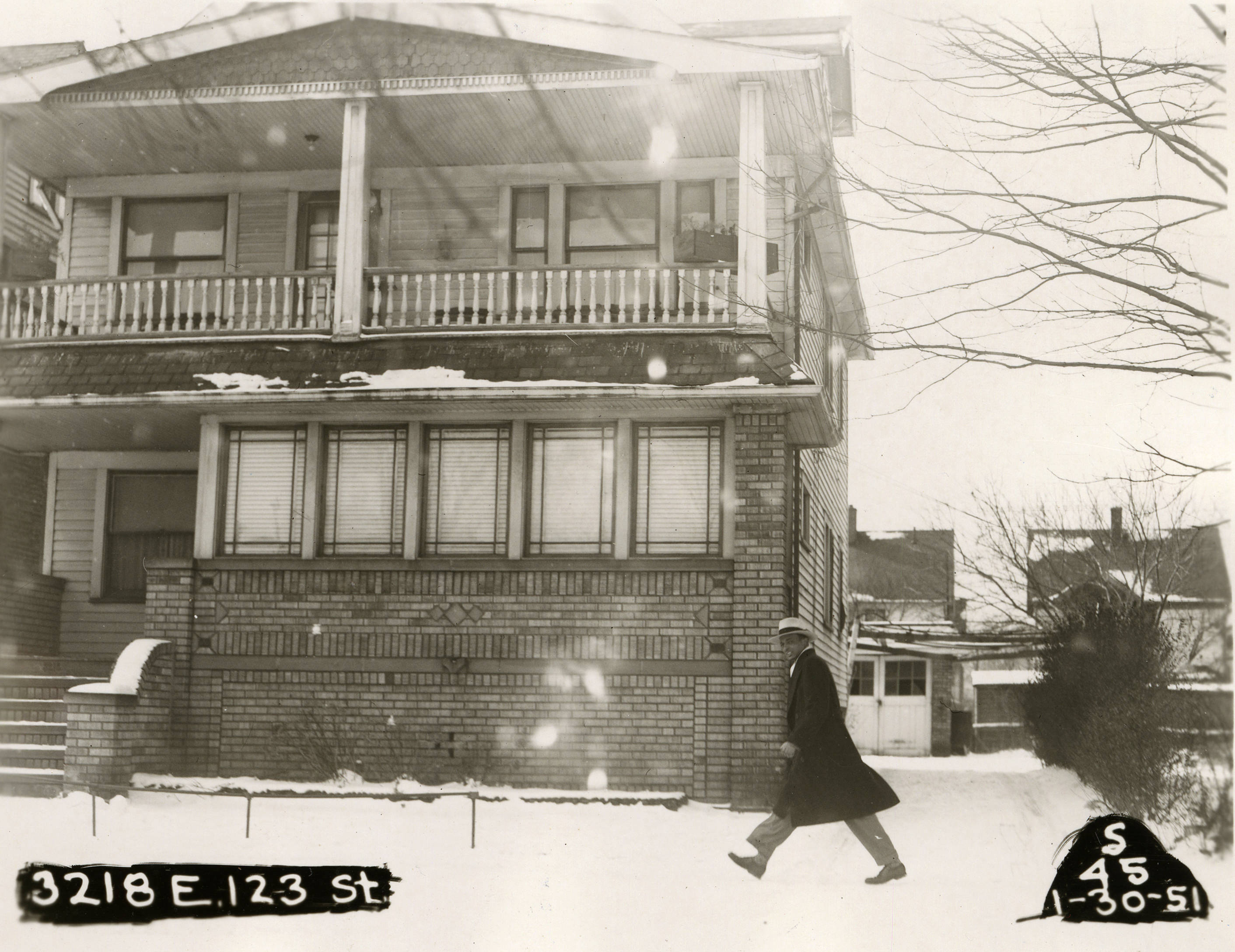
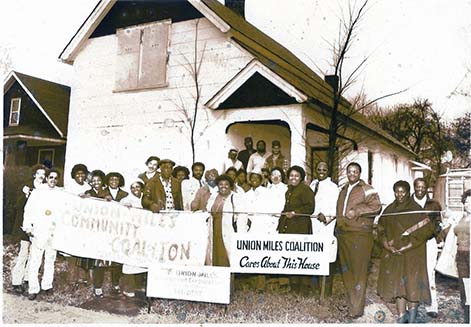
Image courtesy of Union Miles Development Corporation, 1983.
Although Mt. Pleasant was not annexed by the city of Cleveland until 1913, groups of German, Italian and Russian immigrants began to reside in the neighborhood in the mid-1800s. In his book, Surrogate Suburbs: Black Mobility and Neighborhood Change in Cleveland 1900-1980, Historian Todd Minchney notes that Black residences along Kinsman Road were documented as early as 1893, and although the location (between E. 126th Street to E. 130th Street) is accurate, the exact date cannot be verified (Michney 2017, 77). Still, Black homeowners established strong Black enclaves in Mt. Pleasant early on, which was rare in Cleveland during that time period.
Union-Miles (past names include Union-Miles Park and Corlett) was founded as the village of Newburgh in 1814. The area was slowly annexed by the city of Cleveland beginning in 1823. Starting in the 1850s, the population consisted of large numbers of Irish, Scottish, Slavic, and Polish immigrants who worked at the nearby steel mills.
In both Union-Miles and Mt. Pleasant, the Great Migration of African Americans from the southeastern United States led to an increase in the area’s Black population. While both areas were fairly diverse in both racial and ethnic composition, after World War II, white residents began to move out and into the surrounding suburbs, replicating patterns of white flight that were occurring throughout the country. According to the Encyclopedia of Cleveland History, Union-Miles shifted from 10% African American in 1960 to over 90% African American in 1980 (Roy 2020).
This movement occurred alongside Cleveland’s decline as a major industrial city. In the 1960s, both Mt. Pleasant and Union-Miles experienced disinvestment due to increased redlining, predatory lending practices, and structural racism that had begun decades before.
TODAY
Today, despite challenges related to disinvestment, Union-Miles and Mt. Pleasant are known for their churches, iconic restaurants, and vibrant communities. Vacant land has been repurposed into community gardens and public spaces. The Miles Park Historic District, located on E. 93rd Street and Miles Park Avenue, is home to the historic Miles Park library branch, which was built in 1894 as the Newburgh Town Hall. Restaurants and businesses, such as Ray’s Sausage and Mt. Pleasant BBQ, are neighborhood staples that draw customers from throughout Cleveland.
Sources
Hoddersen, Eric. “Chapter 2: The Emerging Community Development System.” Essay. In Community Development in a Legacy City: The Cleveland Lab 1985-2010. Cleveland, Ohio: Cleveland State University, 2023. https://pressbooks.ulib.csuohio.edu/community-development-cleveland-eh/.
Michney, Todd M. Surrogate Suburbs: Black Upward Mobility and Neighborhood Change in Cleveland, 1900–1980. University of North Carolina Press, 2017. http://www.jstor.org/stable/10.5149/9781469631950_michney.
Roy, Christopher. “Mount Pleasant: Encyclopedia of Cleveland History: Case Western Reserve University.” Encyclopedia of Cleveland History, March 12, 2019. https://case.edu/ech/articles/m/mount-pleasant.
Roy, Christopher. “Union-Miles Neighborhood: Encyclopedia of Cleveland History: Case Western Reserve University.” Encyclopedia of Cleveland History, July 13, 2020. https://case.edu/ech/articles/u/union-miles-neighborhood.


Leave a Reply